

Interview with Ginger Vieira: Dealing with Diabetes Burnout
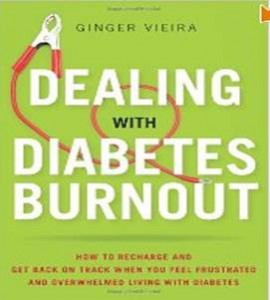 Ginger Vieira knows a thing or two about Diabetes Burnout – she’s been there herself many times but more importantly, she knows even more about getting out of the burnout rut. You might know Ginger from Twitter, or from her YouTube channel, or from her other books. Or you might know her as the person who has been living with diabetes and Celiac disease since 1999 but somehow also found time to get certifications in cognitive coaching, personal training, and Ashtanga yoga and set 15 records in powerlifting (no big deal). She’s amazing, and she’s an inspiration for living well with diabetes. Her new book Dealing with Diabetes Burnout: How to Recharge and Get Back on Track When You Feel Frustrated and Overwhelmed Living with Diabetes shares some of Ginger’s expertise and strategies for dealing with burnout, and I tore through my copy of it over Memorial Day weekend. Today, I’m thrilled to have an interview with the fabulous author herself here on I Run on Insulin. And if you have not already, get your copy of her new book here.
I love how you described that Diabetes Burnout can take many shapes and forms and is different for each person. What are your own classic signs of burnout that you now look out for?
The most common form of burnout for me is this tired, angry little voice that pops in my head when my fingers are sore from too many finger pricks or when my Lantus injection really burns. It’s the daily things we have to do all the time and there are days when I just have this voice that’s like, “Good grief! ARG! This is so obnoxious. I would love to just have one day that was free of sharp objects tearing open my bruised and scabbed fingertips and flesh! Roar!”
And sometimes that voice hangs around for a week, sometimes several weeks. And then suddenly, it goes away for a little while. I go back into autopilot, like we all do, where we stabbed our flesh repeatedly throughout the day and think nothing of it because that’s life with diabetes.
It was fascinating to read about the time in college where you became tired of not feeling well all the time and decided to make very specific changes to your diet. Do you recall an exact ah-ha moment or was it more gradual than that?
Oh yes, the ah-ha moment was when my A1C came back at 8.1 (8.3, I can’t remember which at the moment!). I’d never seen it go into the 8s and there was no mystery as to how it crept up there. I knew I’d been eating things I didn’t need to be eating (ie: pizza, junk, and more junk), I knew I’d been drinking more alcohol than ideal for anybody, and exercise definitely wasn’t a priority. I spent the following 4 months going to yoga classes and trying to teach myself weightlifting basics. After that summer, I came back to my senior year of college ready to rock ‘n roll: I hired a personal trainer (which accidentally lead to all the powerlifting) and started getting my certification to teach Ashtanga yoga. By the end of that year, my whole world revolved around health and fitness, and it felt good!
You talk a lot in this book about our challenging relationships with food as people with diabetes. One (of many!) thing that is hard to manage is when you have made healthy food choices and then are forced to eat again – and something with carbs in it- because you ended up low. This can start the chain of sabotaging ourselves because we feel like we don’t have a choice of when or what to eat when it comes to lows. Do you have any strategies for dealing with that feeling?
Yes. I strongly believe that it’s important to remind ourselves that we do have control over the food we put in our mouths during lows. We can respond to a low in two ways: impulsively and emotionally OR thoughtfully and intellectually. We like to act like we just can’t help but eat everything in the cupboard but we know as we’re doing it that we don’t need all those carbs. I believe it really comes down to making a commitment to yourself, and saying, “I will not abuse my body with food during a low blood sugar. It is not necessary and I do control the way I treat my lows.” From there, I think it’s really important to choose very specific foods to treat lows with, instead of using just any food that happens to be around. For instance, if I’m low at 10 p.m. before bed, sure, I could go downstairs and have a bowl of cereal (which always leads to a high) or I could say, “What I really need right now is 2 glucose tabs or 4 ounces of orange juice.” Just because other food is around doesn’t mean it’s the appropriate choice for a low. Choose your “low foods” and think of them like medicine!
I loved the suggestions you have for how to have conversations with your loved ones about how to support you in the right ways. What’s a great one-liner of support that someone WITHOUT diabetes can say to their loved one with diabetes to show they care?
“Even though I don’t have diabetes, I can see how much work it is every day for you.”
With all of your sports experience, what has being successful in sports (powerlifting, yoga) taught you about being successful in living well with diabetes?
Such a good question! Learning about the discipline required to train and compete in powerlifting (even aside from diabetes) taught me that the way we treat our bodies through food and exercise has an absolute impact on so many aspects of our lives. If I’m eating junk food, I’m gonna feel lethargic and scattered. If I’m committing to getting mostly really healthy foods into my body every day, I’m gonna feel good! It taught me to take the emotional aspect away from food and just appreciate what food can do for me. And that it’s okay to enjoy a bowl of ice cream, but that I choose the ice cream thoughtfully rather than impulsively or out of rebellion against my diabetes.
It was great to reach the contributions throughout the book from other folks with diabetes – the collective experience helps us all know we are not alone. How has community support for diabetes affected your day-to-day management of the disease?
I have definitely met a few people in the DOC who I have learned a great deal from about diabetes management. Specifically, I would say that Jennifer Smith, who is a CDE and has type 1 diabetes (and works with Gary Scheiner at IntegratedDiabetes.com), really taught me how absolutely possible it is to achieve an A1C in the low 6s or high 5s through simply being extra diligent about insulin doses, thoughtful about food choices (note: I didn’t say perfect about food choices), and simply holding yourself to that standard. There are also simply a few people in the DOC who I connect with on a level that feels like true friendship, rather than peer-to-peer support, despite that we only see each other in person once per year, such as Riva Greenberg, Asha Brown, Leann Harris, and Ann Bartlett.
You have a great description at the beginning of the book of what diabetes would look like if it was actually a “job” instead of disease (24 hours a day, no breaks, no vacations). If diabetes actually was a job and you HAD to pick some “perks,” what would they be? (more mindfulness of what’s going in to your body, for example? Better understanding of foods?)
Oooh! Clever question! Boy. That’s a tough one. It’s fun to try and wonder what I would be doing with my life if I didn’t have diabetes, or how my personality might be different. I wonder if I would’ve gotten into powerlifting and weightlifting if I didn’t have diabetes, because part of my motivation was definitely to prove that diabetics could be athletes. I also wonder what the heck I would be writing about if I didn’t have diabetes because I’ve always been a writer. I’ve wanted to write books since the 2nd grade (I was diagnosed with type 1 in 7th grade). I know I’m not directly answering the question but I guess that’s because I think the “perks” of diabetes are so different from person to person…and for those who think diabetes has brought nothing good to their life, I’d suggest taking a deeper look!  It’s easy to see the negatives that diabetes brings to our lives, but we have to create the positives and be open to them happening.
If your readers take away only one lesson or inspiration from the book, what would you hope it to be?
That it’s totally okay to be sick and tired of diabetes. That it’s totally okay to slack-off for a week or two, or a month! That it’sokay to be burntout! And we should expect to feel burnout every now and then. It’s okay. It’s not failure. It’s realistic.
Did you enjoy this post? Why not leave a comment below and continue the conversation, or subscribe to my feed and get articles like this delivered automatically to your feed reader.
Comments
No comments yet.
Leave a comment